
Platform for modeling viable systems that automatically manage the user’s assets and resources
Driven by the user’s preferences and goals. Grounded in Ludwig von Bertalanffy’s General Systems Theory and Jay Forrester’s system dynamics
About the project
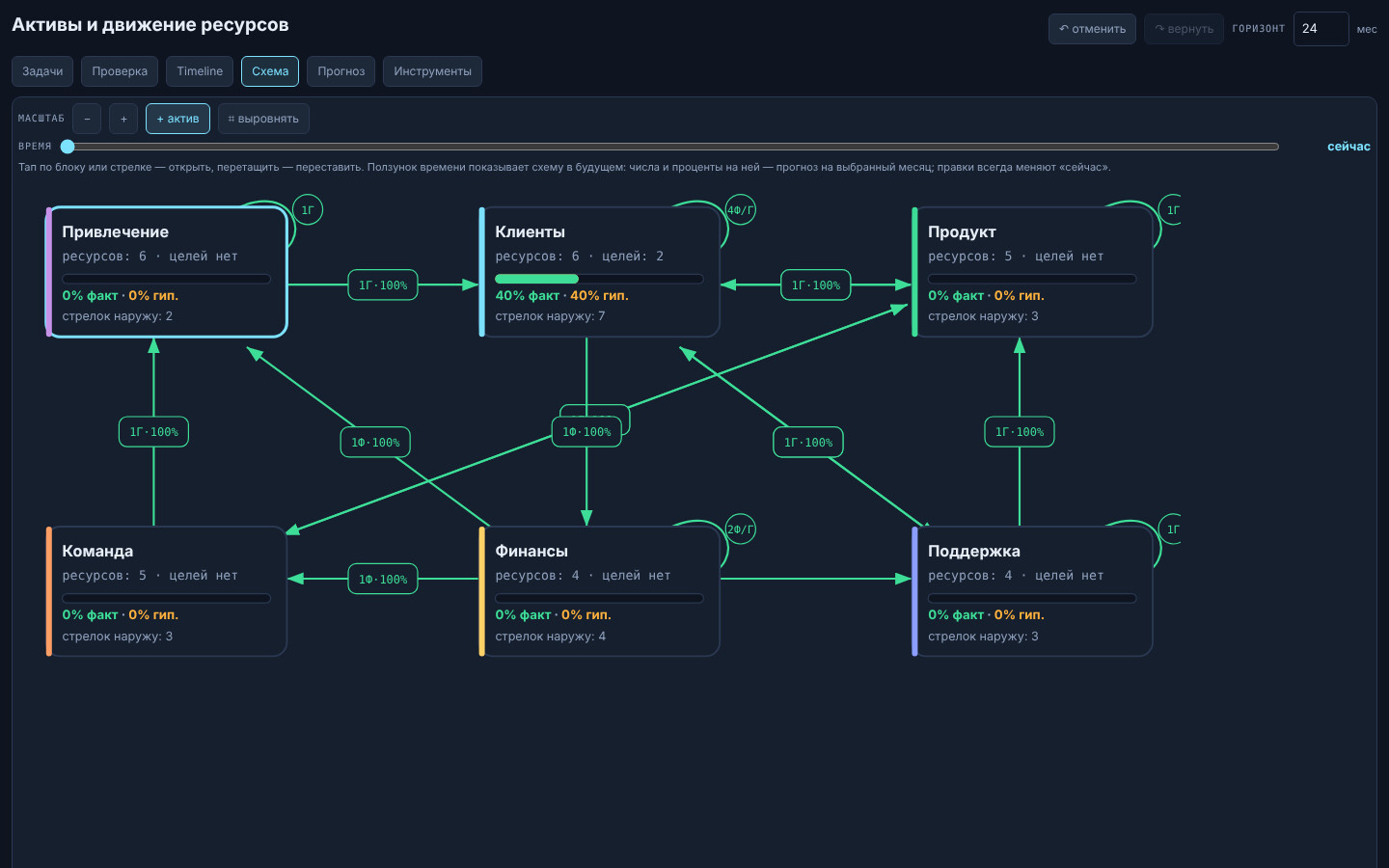
A product for people who want to manage a business or their own life as a transparent system with no black box: you can see what assets and resources it consists of, how they move and what results they bring. These can be company processes or a person’s own processes: diet, workouts, events. Tasks are carried out by people or AI agents that notify the user of the results. The application calculates how the subjects of the system influence each other and external objects, using methods of general systems theory and system dynamics.
Interface
Tech stack
Task
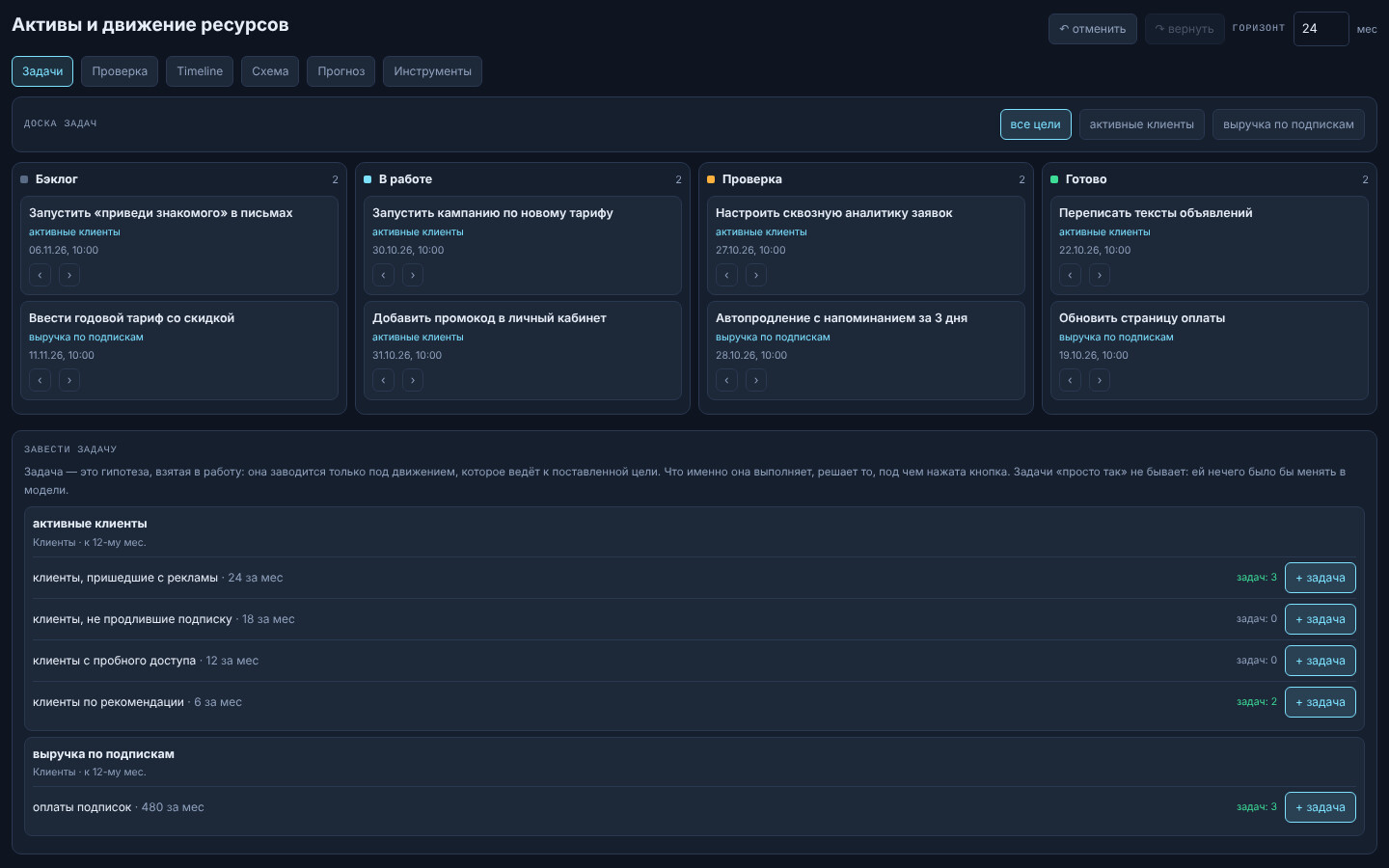
Build a system in which a goal turns into a plan of action. Both people and AI agents must be able to set, carry out and review tasks, and every change in the model must be visible and verifiable.
Constraints
The model has to be transparent: every figure on the map is explainable, and flow conditions are written as formulas that are parsed without executing arbitrary code. Scenarios contain personal and business data, so they are encrypted and can be stored on the application server or with the user: on their own servers or even on a home computer. A complex model had to fit on a mobile screen inside Telegram. The product is developed by neural networks: programmers hardly write code by hand and instead design the approaches, skills, rules and scripts that agents use to program the application.
Solution
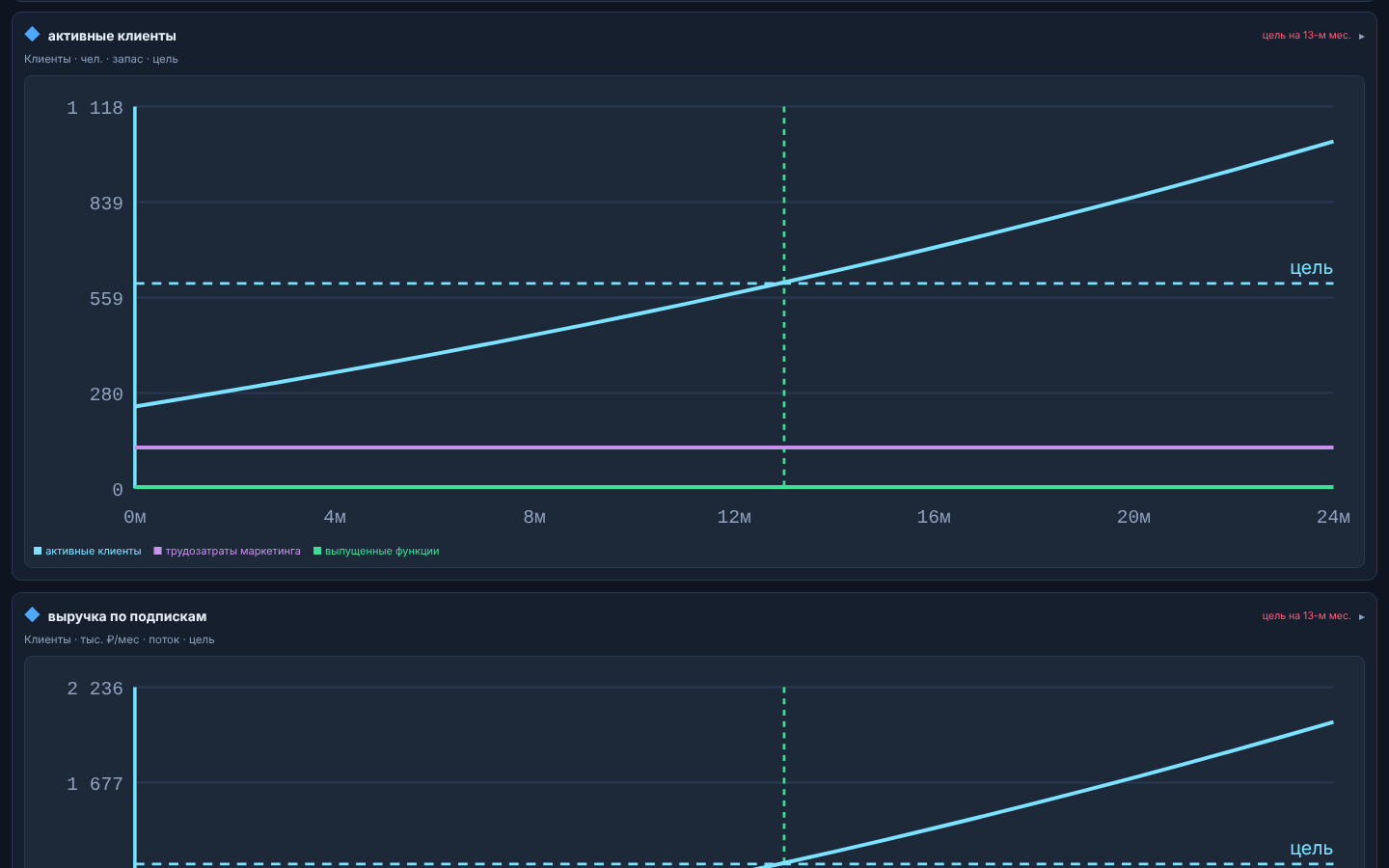
A system is described through assets, resources and the conditional flows between them. Based on the user’s goals, the application calculates how the subjects of the system influence each other and external objects, builds a month-by-month forecast, identifies which flows need to be strengthened and suggests key results that become tasks. A person or an agent can set, carry out or review a task. Agents keep their own memory and learn by editing their skills for each task. The calls module records each participant’s voice on a separate channel and transcribes the recording after the conversation. In the built-in services marketplace, users can exchange services, bring external contractors into their own processes and automate the exchange of resources between them.
Challenges
Flows depend on each other through conditions, so each model step is computed iteratively until it reaches a steady state. The calculation core is separated from the interface and verified by numeric tests. Managing development in which the code is written by neural networks is a task of its own: engineers define approaches, skills and rules, and the result is checked by tests on every change.
Further development
The calculation core is separated from the interface, and agents and their skills are defined as data. This makes it possible to add new types of conditions, agent roles and scenarios for personal and business processes without reworking the foundation.
Result
We launched a Telegram Mini App in which the user sets a goal: how many resources to accumulate, by when, and what effort, assets and resources they are willing to spend on it. Based on the goal, the application calculates what to do and when, shows a month-by-month forecast and creates tasks for people and agents. User scenarios are encrypted and stored either on the application server or with the user.